Service Portfolio
Foundation Waterproofing
Structural crack repair, liquid and sheet membrane assemblies, footing drains and site edge drains — below-grade waterproofing done as a complete system, start to finish.
Stop Water at the Wall
A leaking below-grade wall is almost never one problem. It's cracks that were never structurally repaired, a wall face with no real membrane on it, and water with nowhere to go once it gets there. Around Metro Detroit, clay soils and freeze-thaw cycles push groundwater against foundations all year long, and anything less than a complete system just moves the failure somewhere else. So we treat it as one scope: repair the structure, build the membrane assembly, then give the water a path out.
Because we run our own excavation crew, all of it stays with one contractor — the digging, the crack repair, the coating and membrane, the drain tile, the compacted backfill, and the concrete or asphalt patch-back at the end. That matters on this work, because the failures usually happen at the handoffs: backfill that was never compacted, a discharge line nobody tied in, pavement left broken for another trade. We open it, we fix it, we close it back up.
How We Build It
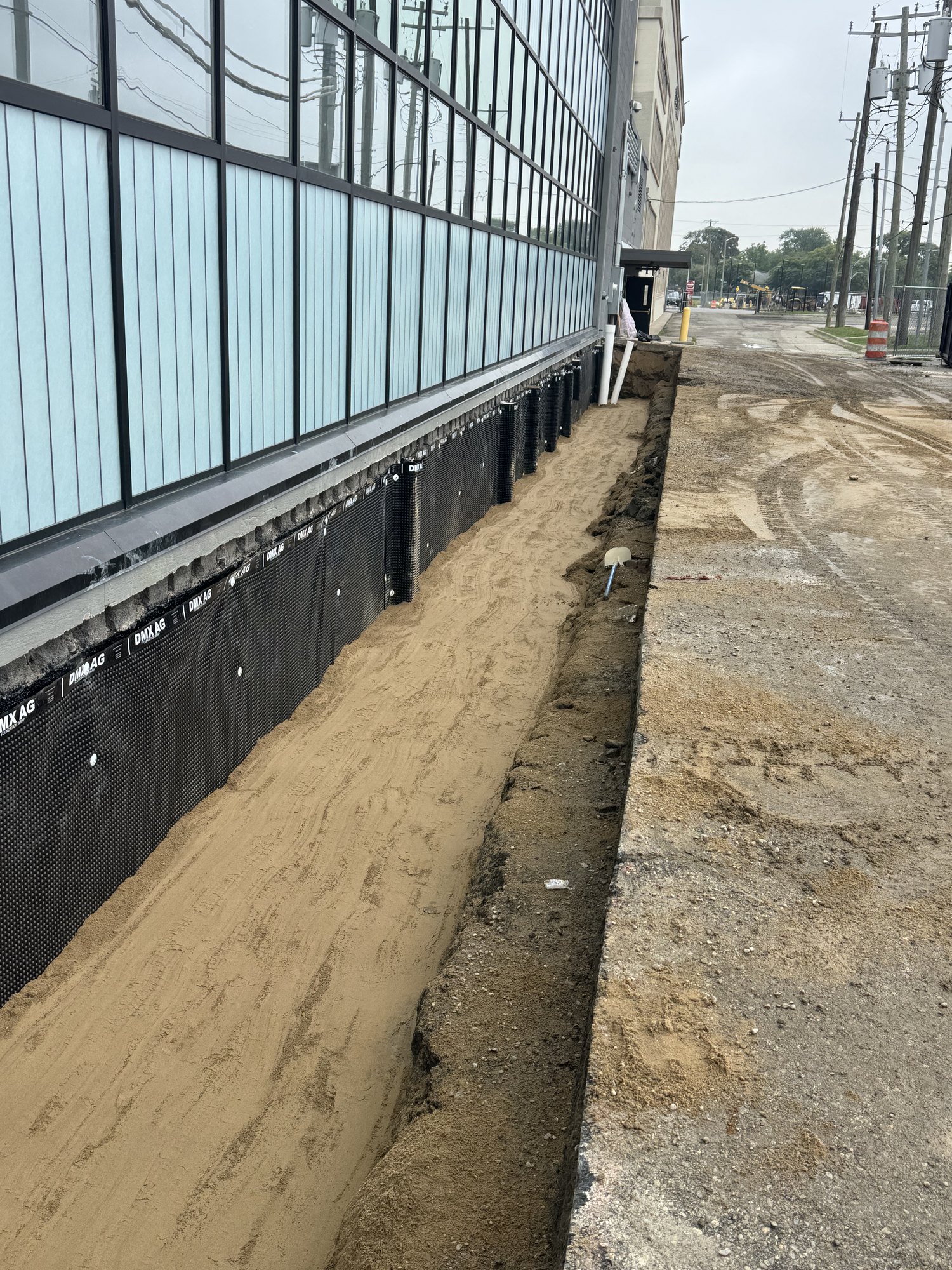
Below is the actual build-up from a recent commercial job in Metro Detroit — the same details you'll find in the photo set on this page. If you're an owner, a GC, or a municipal engineer comparing bids, this is what a complete scope looks like.
Structural Crack Repair
- Cracks located and marked
- Cut out in a deep V, full depth
- Rebar pins drilled and set across the break
- Waterstop installed inside the V
- Formed and poured back with concrete
Wall Membrane Assembly
- Liquid-applied membrane on the wall face
- Self-adhering sheet membrane bonded over it
- Dimple board as the drainage and protection course
- Footing drain tile in washed stone
- Backfill in compacted lifts, regraded
Surface Edge Drain
- 6" sock-wrapped double-wall HDPE perforated pipe
- Pea stone cover over the pipe
- Filter fabric over the pea stone
- Class II sand above the fabric
- 6" of 21AA crushed concrete as the top course
What We Offer
Structural Crack Repair
Cracks cut out in a deep V, rebar pins set across the break, waterstop installed in the cut, then concrete poured back full depth. The section gets replaced and tied together — not caulked.
Liquid-Applied Waterproofing
A continuous liquid membrane applied directly to the below-grade wall, sealing the surface and working into every block joint and imperfection before the sheet goes on.
Self-Adhering Sheet Membrane
A self-adhered sheet membrane bonded over the liquid coat. Two independent layers of waterproofing on the wall, not one — which is what makes the assembly hold up long term.
Dimple Board Drainage Course
Dimple board over the membrane creates an air gap so any water reaching the wall runs down to the tile instead of sitting against it. It also protects the membrane during backfill.
Footing Drains & Site Edge Drains
Perforated tile at the footing in washed stone, plus sock-wrapped double-wall HDPE edge drains at the surface where the site needs to shed water away from pavement.
Excavation, Backfill & Restoration
We open it, we close it. Machine and hand excavation, backfill in compacted lifts, regrading, and patch-back of the concrete or asphalt we had to cut.
Our Process
Assessment & Scope
We walk the building, find where water is actually entering, mark every crack, and check grades and discharge options. Written scope, no charge.
Excavate & Repair
MISS DIG locates, then we open to the footing. Cracks get V-cut, pinned with rebar, waterstopped, formed and poured back full depth.
Build the Assembly
Liquid membrane goes on the wall first, then the self-adhering sheet over it, then dimple board as the drainage and protection course.
Drainage
Footing tile bedded in washed stone with consistent fall to a positive discharge, plus surface edge drains where the site calls for them.
Backfill & Restore
Compacted lifts, regraded to shed water away from the building, hard surfaces patched back, cleanout risers left accessible.
Common Questions
What's the difference between exterior waterproofing and an interior drainage system?
Interior systems manage water after it has already reached your wall and slab — they collect it and pump it out. Exterior work stops it earlier: repair the cracks, build a membrane assembly on the outside face, and give water a path down to drain tile instead of through the wall. Exterior costs more up front because it requires excavation, but it addresses the cause rather than the symptom. Which one makes sense depends on your building, your access, and what's failing — we'll tell you honestly if an interior system is the better value on your site.
Why cut a crack out and pour it back instead of just filling it?
A surface fill bridges the crack but doesn't tie the two sides together, so the wall keeps moving and the repair opens back up. Cutting a deep V, drilling rebar pins across the break, setting waterstop in the cut, and pouring concrete back full depth does three things a caulk bead can't: it restores the section, it mechanically stitches both sides together, and the waterstop blocks water from traveling through the repair. It's more work. It's also the difference between a repair that lasts and one you revisit in two years.
Why put both a liquid coating and a sheet membrane on the same wall?
They fail differently, so together they cover each other. The liquid is continuous and works into block joints, rough spots, and transitions where a sheet is hard to seal tight. The sheet adds thickness, consistency, and resistance to damage. Put the liquid on first and bond the sheet over it, then protect the whole thing with dimple board before backfill, and you've got an assembly rather than a single point of failure. Plenty of jobs get one layer — on a commercial wall that's going back under grade and won't be seen again, two is the right call.
How much of my parking lot or landscaping has to come up?
Only the strip along the wall we're working on — typically a few feet out from the building, plus room to work the machine. We fence and cone the area, keep access open where we can, and phase the work on commercial sites so you're not shut down. Whatever pavement, curb, or lawn we open gets restored as part of the job, and that's in the estimate from the start.
Do you handle residential foundations too, or only commercial?
Both. The photos on this page are from a commercial building, but the approach on a house is the same — excavate to the footing, repair what's cracked, build the membrane assembly, tile and stone at the base, compacted backfill, restore the surface. Residential jobs are usually faster and tighter on access, which is where having our own excavation crew helps.
Project Photos (22)
Ready to Start Your Foundation Waterproofing Project?
Call us 24/7 or fill out a quick form. We'll follow up within 24 hours with a free consultation.